Overview
Automatic payments are a convenient way to streamline billing by securely charging a customer's saved payment method on a set schedule or upon completion of a service. This helps businesses get paid faster, reduce manual work, and minimize missed or late payments, improving overall cash flow and customer satisfaction.
This article will review:
Settings and Navigation
For Automatic Payments to run, the following conditions must be met:
Navigate to Control Panel > Services > Invoicing, edit the applicable service(s), and check the Auto Pay When Complete box. 
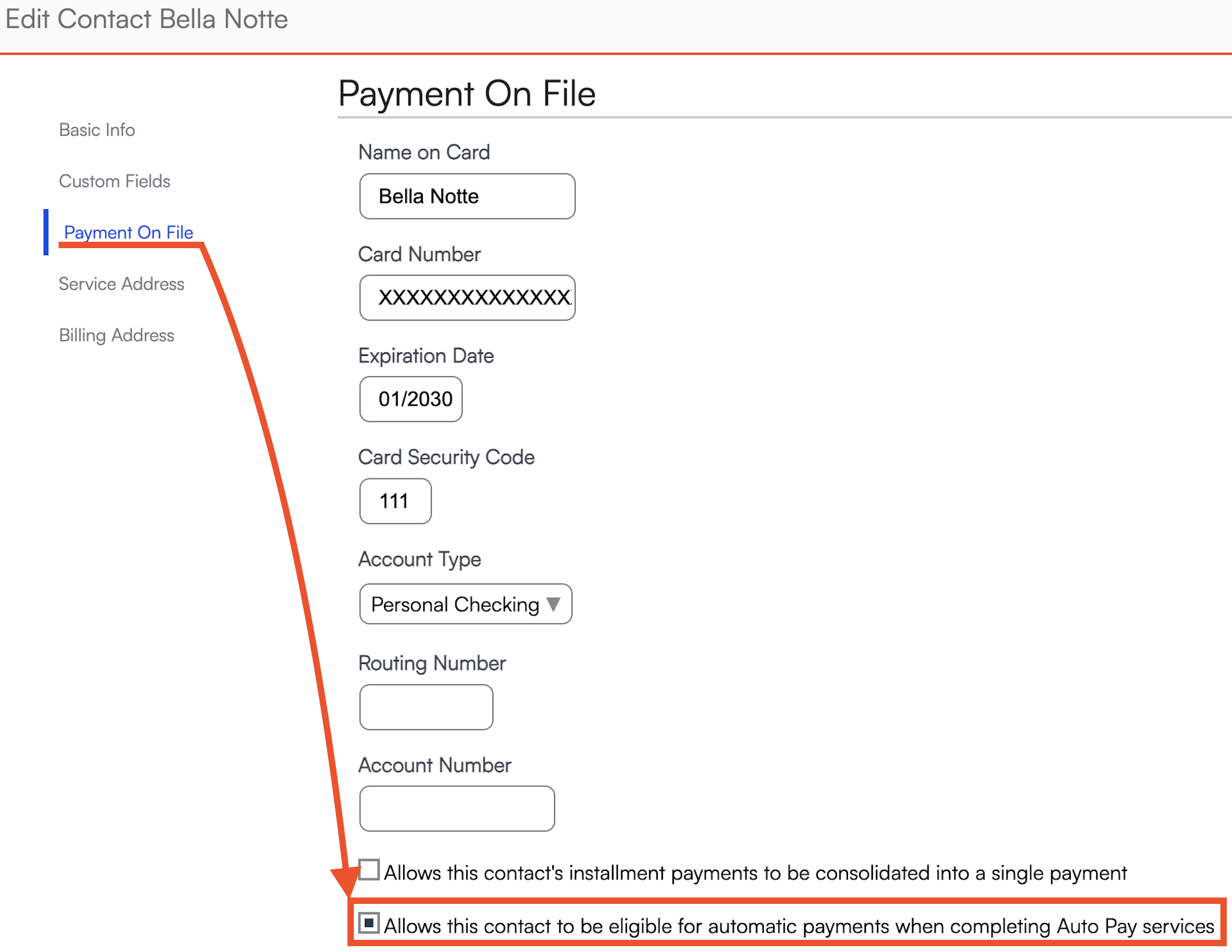
Opt the contact in to Auto Pay by ensuring a card is on file and the Auto Pay box is checked. The Consolidate Payments box is optional - read more about that feature below.
Review your settings in Control Panel > Integrations > Payments.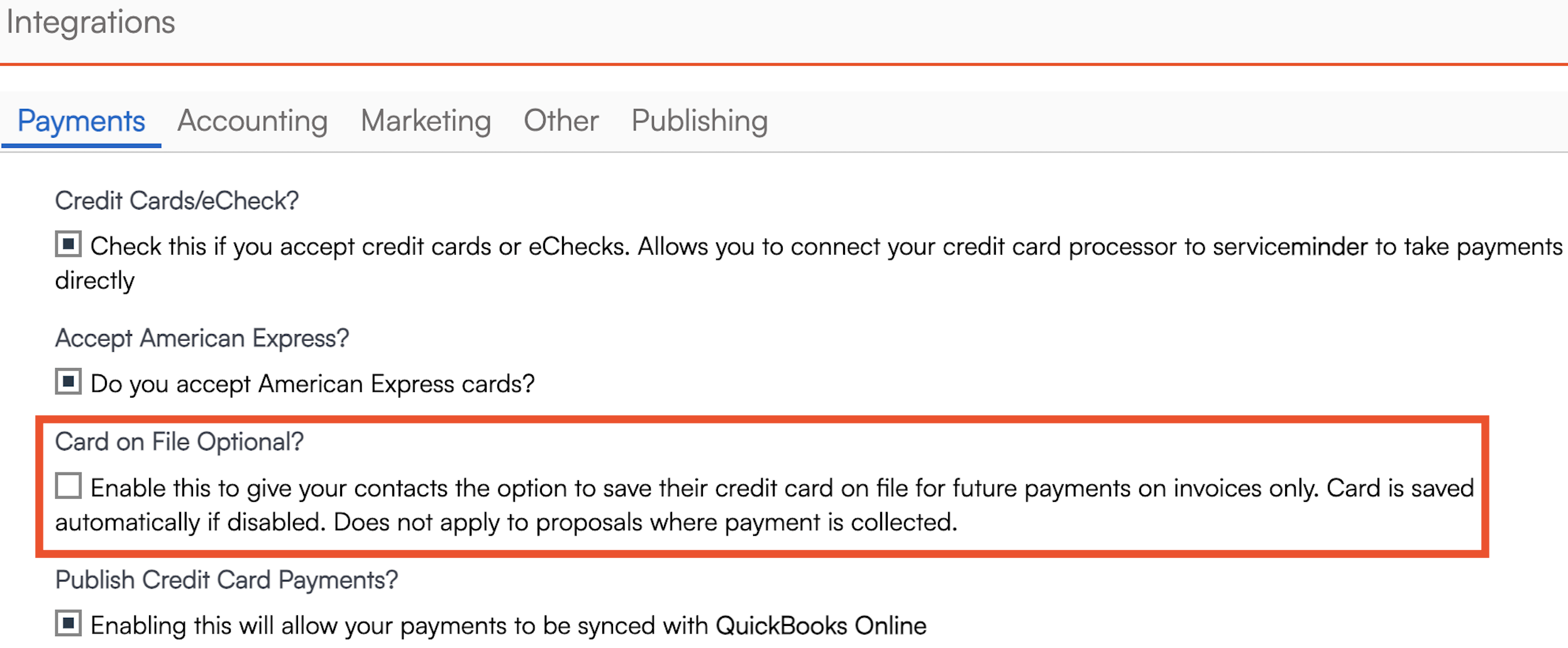
If Card on File Optional is checked, customers are allowed to choose if their card is saved on file. You can always enter their card information manually in the system, but if you want to save it automatically when they enter it themselves, make sure this box is not checked.
Using Auto Pay
If Auto Pay is on when the appointment is finished, and the contact has a card on file, we will generate an Installment Payment scheduled to run shortly. This will charge the contact's card and apply the payment to the invoice and send them a receipt.
Failed Payments
If the payment fails, the installment payment will be in failed status (listed in the Failed Payments snapshot) and will send a notification to the contact that it failed with a link for them to click and update their card on file. When they do this, the charge will try again immediately and the payment will be applied to the invoice.
The installment payment will continue to be tried daily, up to 2 more times, until it is successful or runs out of retry attempts.
If the contact does not have a card on file, we will send them the invoice to prompt for payment and to store the card on file for future services.
Consolidate Payments
If you have Consolidate Payments enabled, Auto Pay will still create the installment payment but it won't run the card. All Auto Pay generated installment payments will instead run on the configured day and time.
When consolidated payments run, it will group all pending installment payments from prior appointments, charge the contact's card for the total amount of those payments and then apply that payment to the corresponding invoices.
Consolidating payments does not affect the original invoices. If you have 4 appointments that each generated a $25 invoice and consolidated payments are used, we will run a single charge for $100 and apply that payment to all 4 invoices.
Enable Consolidated Payments
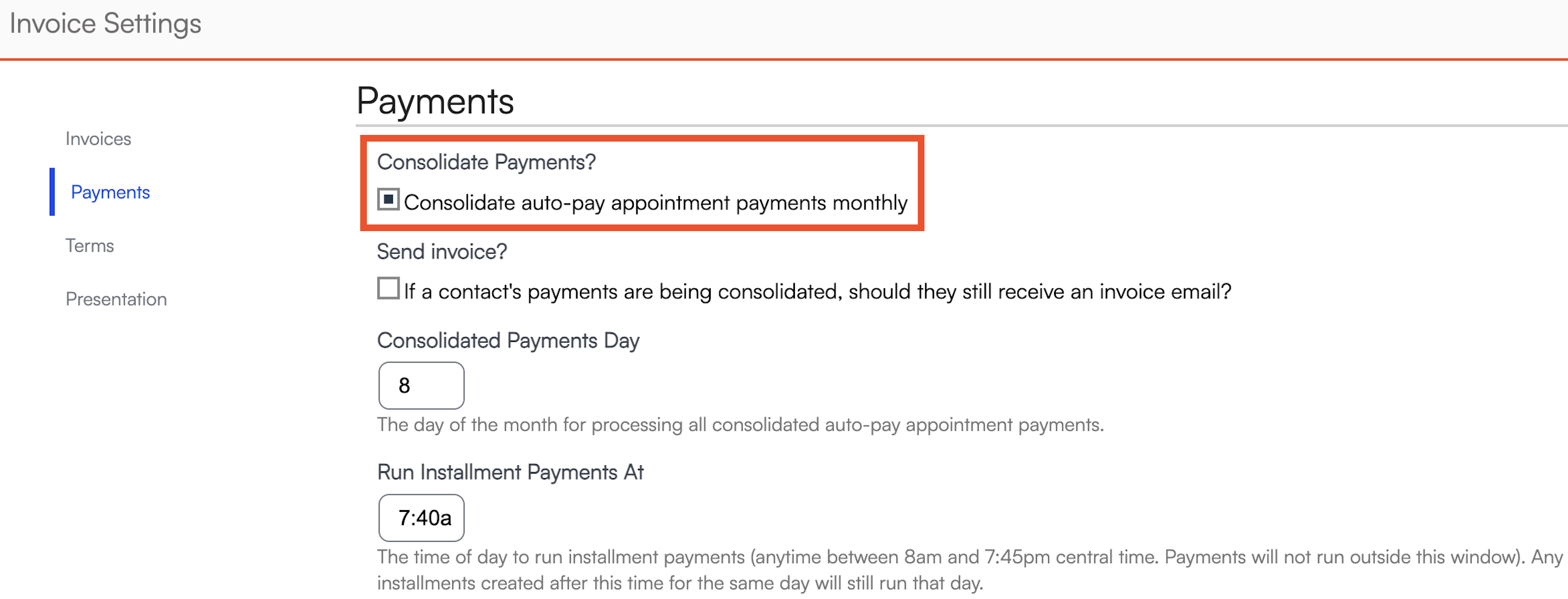
- Go to Control Panel > Invoicing, navigate to the Payments section and check the box Consolidate Payments.
- Select a date and time to run payments each month and choose whether or not to send separate invoice emails. The invoice emails are separate from the receipt email, which will be sent once per month when the payment is run.
- Select a date and time to run payments each month and choose whether or not to send separate invoice emails. The invoice emails are separate from the receipt email, which will be sent once per month when the payment is run.
- Navigate to Control Panel > Services, edit the applicable service(s), and check the Auto Pay When Complete box.

- When adding or editing a contact, check the boxes for Consolidate Payments and Auto Pay to opt them in.
Note: When adding a new contact, Consolidate Payments will default to the organization-level setting. This means it will automatically default to "On" for all new added contacts if it is enabled for your organization and you must turn it off for any new contacts that you wish to exclude.

If contacts are in a "Managed By" relationship, Consolidated Payments will apply as long as both parent and child are opted in to Consolidate Payments and Auto Pay AND the parent contact (manager) has a card on file.
Consolidated payments will not run if there is no payment on file (credit card or ACH). If you do not have a payment on file for a customer, but they want to pay multiple invoices at once with one payment, you can send them their Statement Link instead. Find the Statement Link via Contact Details Page > Invoices Tab. 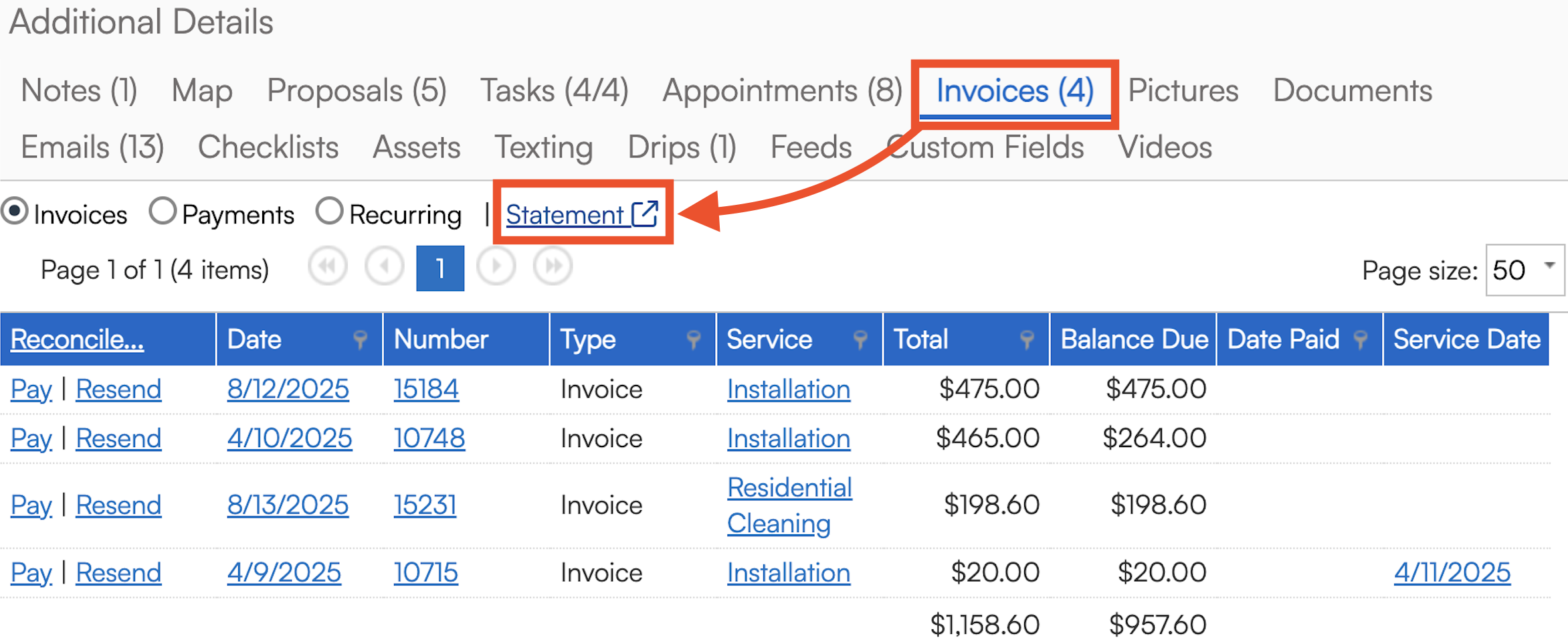
Transaction Error
If that transaction fails, we will send a notification to the contact and retry over the next two days. If the contact updates their card on file from the notification, we will run a single consolidated payment and apply to the open invoices.
Schedule
The auto-payments function only process payments between 8 a.m. and 8 p.m. in your timezone. This is intended to be a client-friendly favor so they aren't getting payment notifications on their phones at odd hours.
Consolidated Invoice Statements
When Consolidated Payments is enabled, you can choose to send clients one consolidated invoice per billing cycle instead of an individual invoice for each appointment.
-
Enable at the organization level: Go to Control Panel > Invoice Settings > Payments and select the Consolidated Invoices checkbox (requires Consolidate Payments to be enabled).

-
Opt-out at the contact level: From the Contact Detail > Payment on File section, you can turn off consolidated invoices for specific accounts.

Each consolidated invoice is generated on the scheduled payment date. It includes all open invoices for the billing period with:
- Original invoice numbers, services, descriptions, and dates
- Full itemized breakdown and credits applied
- Account total due, payment status, and terms
Statements are:
- Emailed automatically to the primary contact and any CCs using the automated email template titled "Statement Ready Notification"
- They will be emailed on the day of the month that is entered into the Consolidated Payments Day.
- If Consolidated Payments are not set up, no payment will be charged but the invoice statement will still be sent.
- Emails will include a link to view the statement on the web as well as a PDF copy of the statement for download.
- Stored in the contact record under the Additional Details section in the Consolidated Statements tab. for re-download or resend by period (MM/YYYY)
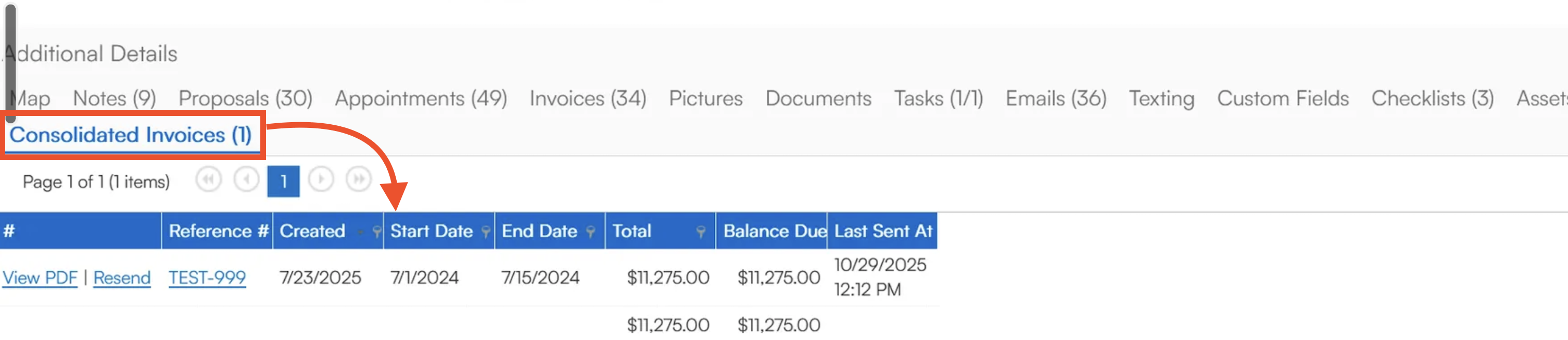
- When viewing a statement, select a different date range using the "View Another Statement" dropdown menu to quickly navigate between statements.
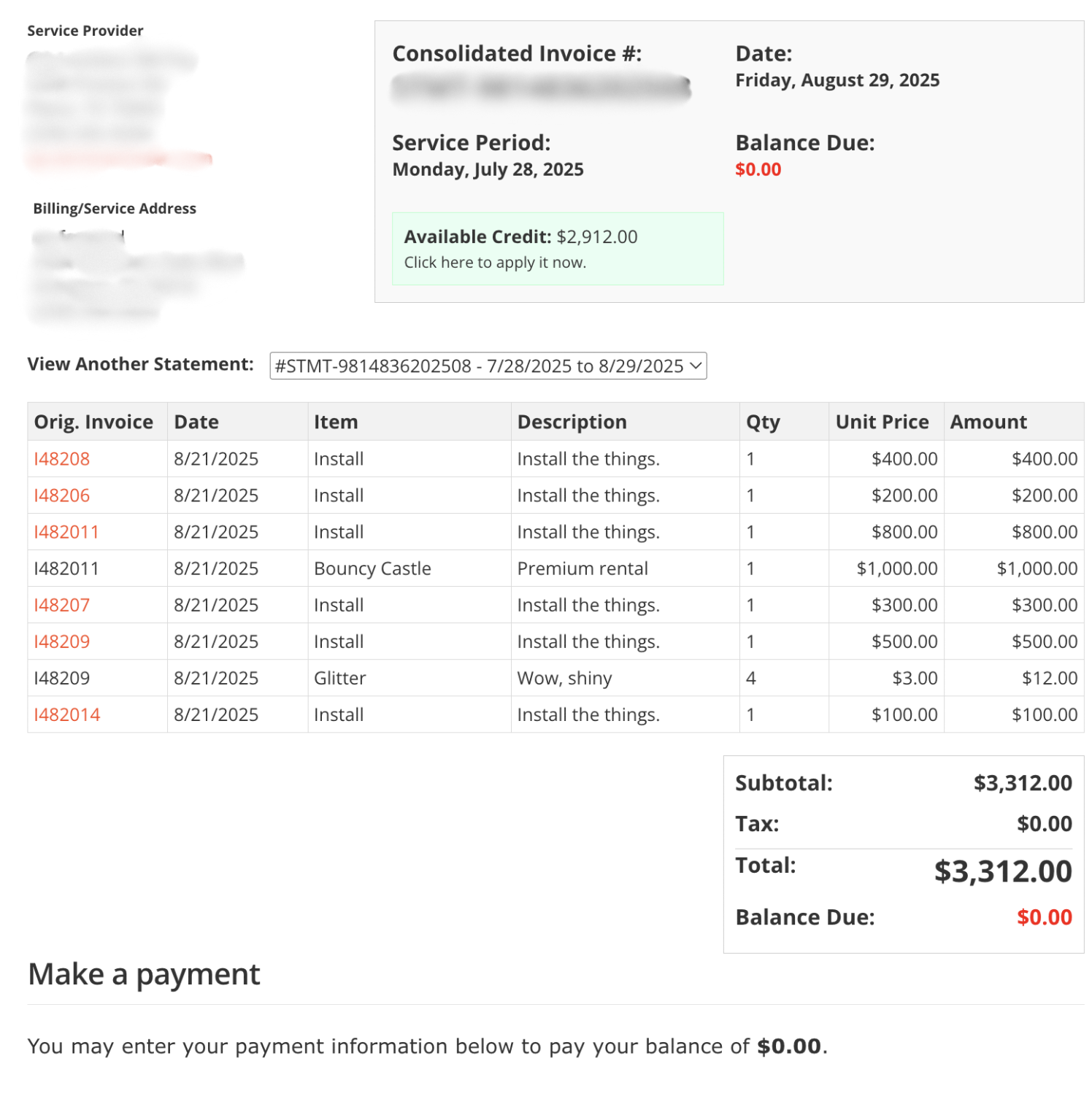
- When viewing a statement, select a different date range using the "View Another Statement" dropdown menu to quickly navigate between statements.
FAQs
If we want consolidated payments to happen on the last day of the month, should we put 31? Or would putting 31 cause all the months that end in 30 or Feb to miss?
Setting the consolidated pay date for 31 will run on the last day of each month (i.e., June 30 or February 28).
How do I know if someone has their card on file?
You will see it on their Contact Details Page. There is a Card on File section that appears with a blue pencil and an X next to it in case their cc information needs to be updated or you want to remove that cc completely.
Will historical invoices be backfilled into statements with Consolidated Invoicing?
No. Consolidated invoicing begins after your organization enables it. Past invoices remain as-is.
